
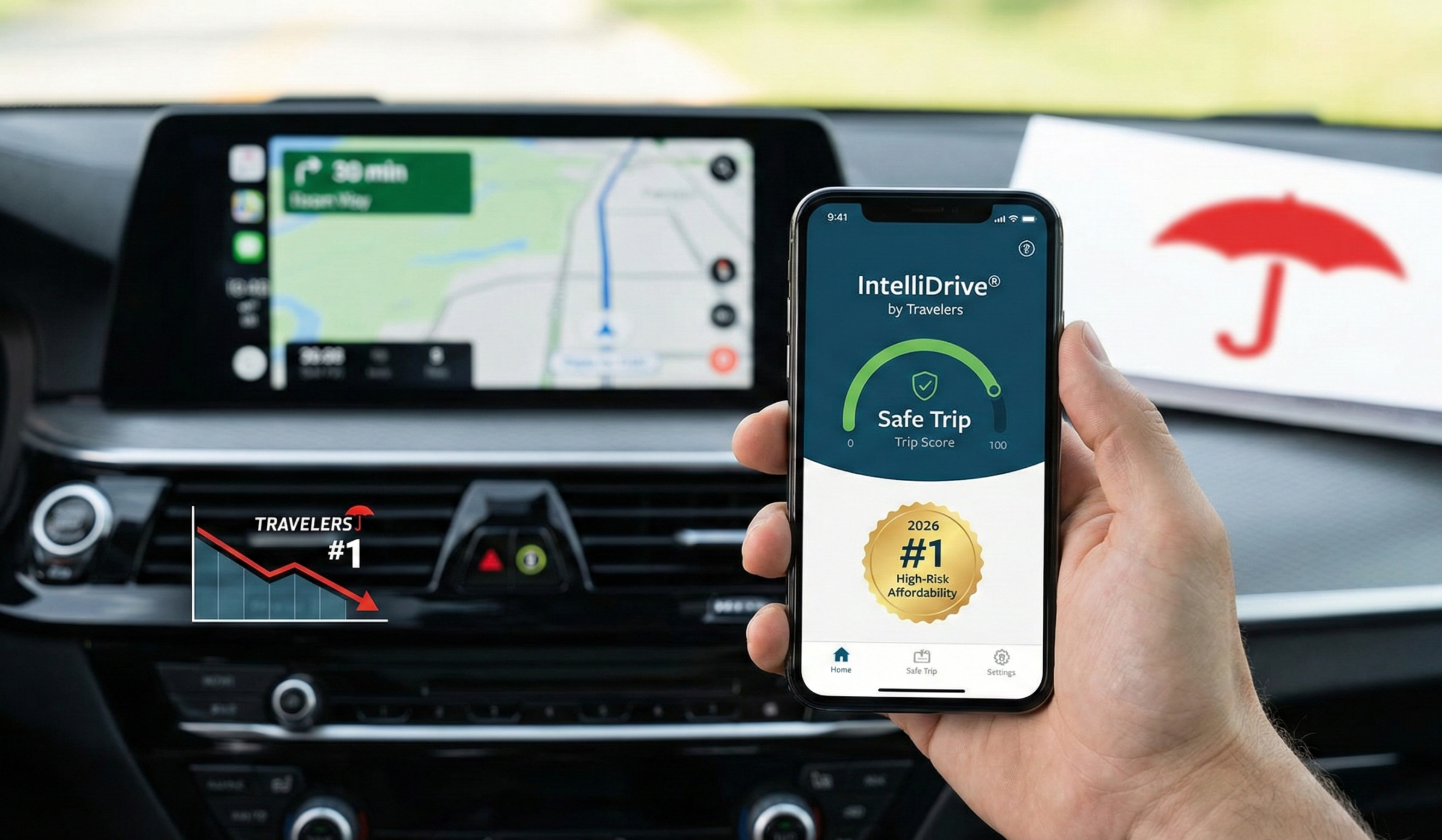
Travelers Climbs to #1 in 2026 Car Insurance Rankings for High-Risk Driver Affordability
The landscape of the American auto insurance market has reached a pivotal turning point in 2026. For years, drivers labeled as “high-risk”—those with a history of speeding tickets, at-fault accidents, or lower credit scores—faced a daunting reality: skyrocketing premiums that often bordered on the unaffordable. However, the latest industry analysis for January 2026 reveals a significant shift. Travelers Insurance has officially claimed the #1 spot in national rankings for High-Risk Driver Affordability, surpassing long-standing competitors like GEICO and Progressive.
This achievement is not merely a result of aggressive pricing; it is the culmination of a multi-year strategy centered on data-driven underwriting, expanded telematics integration, and a specialized approach to risk rehabilitation.
1. The High-Risk Dilemma of 2026
To understand the magnitude of Travelers’ ascent, one must first look at the state of the industry. In 2026, the average cost of full-coverage car insurance in the U.S. has stabilized at approximately $2,339 per year. However, for a driver with a single DUI or a major at-fault accident, that figure can easily double.
According to the latest data from The Zebra and NerdWallet, high-risk drivers in early 2026 are paying an average of 38% more than those with clean records. In this high-pressure environment, affordability has become the single most important factor for consumer retention. Travelers has met this demand by offering full-coverage rates that average $1,656 per year—nearly 30% below the national average—even for many drivers in non-standard risk pools.
2. Why Travelers Took the Top Spot: The IntelliDrive® Edge
The engine behind Travelers’ affordability is its advanced telematics program, IntelliDrive® and the newly expanded IntelliDrive 365. Unlike traditional “static” insurance models that judge a driver solely on their past (e.g., an accident from three years ago), Travelers’ telematics focus on current behavior.
Real-Time Risk Assessment
By utilizing a smartphone-based app, Travelers monitors key driving metrics:
- Braking and Acceleration: Identifying smooth vs. erratic driving patterns.
- Speeding: Comparing vehicle speed against local limits.
- Time of Day: Recognizing that driving between 11 p.m. and 4 a.m. poses statistically higher risks.
- Distraction-Free Streaks: A proprietary feature that rewards drivers for not interacting with their phones while in motion.
The impact on affordability for high-risk individuals is profound. A driver with a speeding ticket on their record might normally face a massive premium hike. However, through IntelliDrive, if that same driver demonstrates 90 days of disciplined, safe habits, they can secure a renewal discount of up to 30%. This “behavioral bypass” allows Travelers to offer lower rates to “technically” high-risk drivers who are actively improving their safety profile.
3. The “Privacy Premium”: Is the Discount Worth It?
While the $600+ annual savings are attractive, drivers must understand the mechanism behind Travelers’ #1 ranking. It is a shift from Demographic Pricing to Behavioral Pricing. The “Big Brother” Factor: Travelers isn’t just giving you a cheap rate because they are nice. They are doing it because IntelliDrive creates a digital fence.
- The Risk: If you sign up for the discount but continue to brake hard or use your phone, your rate won’t just stay flat—it could actually go up at renewal in some states.
- The Opportunity: For a high-risk driver who has truly reformed (e.g., someone with a past DUI who now drives cautiously), this is the only way to bypass the “penalty box” of traditional underwriting.
4. Strategic Underwriting: Precision Over Generalization
In the 2026 market, many insurers have moved toward broad “block” exclusions or heavy surcharges for certain zip codes and demographics. Travelers has taken a different route by refining its predictive modeling.
The Role of AI in “Risk Rehabilitation”
The Swiss Re Institute recently noted that fragmented data can lead to higher insurance costs. Travelers countered this by investing heavily in AI-driven underwriting that looks at more than just a credit score or a DMV report. Their 2026 models incorporate:
- Vehicle Safety Tech Discounts: Giving more weight to cars equipped with advanced driver-assistance systems (ADAS), which reduce the severity of “high-risk” accidents.
- Credit-Forgiveness Programs: For drivers whose high-risk status is linked to poor credit rather than poor driving, Travelers has introduced tiered structures that weigh recent financial stability more heavily than long-term debt history.
Comparative Affordability: 2026 Data Points
In a head-to-head comparison of median annual rates for 2026, Travelers consistently outperformed other major carriers in the high-risk segment:
| Driver Profile (Full Coverage) | National Average | Travelers Average | Savings |
| Clean Record | $2,339 | $1,656 | $683 |
| One Speeding Ticket | $2,991 | $2,129 | $862 |
| One At-Fault Accident | $3,465 | $2,279 | $1,186 |
| One DUI Conviction | $4,379 | $2,891 | $1,488 |
Source: Consolidated Industry Data, January 2026.
5. Customer Experience and Digital Transformation
Beyond price, Travelers has climbed to #1 due to its Digital Experience Ranking. High-risk drivers often face more friction during the claims process. Travelers addressed this by launching a specialized “Concierge Claims” service for those enrolled in their telematics programs.
By using the data from the IntelliDrive app at the moment of impact, Travelers can often initiate a claim before the driver even calls. This efficiency reduces the administrative overhead and “fraud-risk margin” that usually drives up costs for the high-risk pool. In 2026, 89% of Travelers’ customers reported high satisfaction with the digital claims process, the highest among national carriers.
6. Market Implications: A Wake-Up Call for the Industry
The success of Travelers in 2026 is forcing a shift in how the entire industry views “bad” drivers. For decades, the strategy was to price high-risk drivers out of the market to protect the bottom line. Travelers has proven that with the right technology, these drivers can be managed into profitability rather than excluded.
Industry analysts suggest that this #1 ranking will lead to a significant migration of “non-standard” market share toward Travelers. Competitors like Progressive, traditionally the kings of the high-risk market, are now being forced to recalibrate their own telematics offerings to keep pace with Travelers’ aggressive 2026 rates.
7. Action Plan: How to Hack Your Rate in 2026
If you have a “red flag” on your record, follow this 3-step strategy to leverage Travelers’ new position:
Compare the “Total Cost”: A cheap premium is useless if the deductible is $2,000. Ensure the Travelers quote matches your current coverage limits before switching.
The 90-Day Audition: Don’t just switch blindly. Download the IntelliDrive app before your current policy expires to see if your driving style actually qualifies for the discount.
Check the “Forgiveness” Tier: Ask a Travelers agent specifically about their “Responsible Driver Plan.” In 2026, they are more lenient on isolated incidents (like one minor fender bender) than competitors like State Farm.
8. Final Verdict: A Data-Driven Bargain
Travelers has rightfully earned the top spot by using technology to lower costs for those who need it most. They have proven that a past mistake shouldn’t dictate your future premiums forever. Community Question: Would you let an insurance company track your every move via GPS in exchange for a 30% discount? Or is your privacy worth paying a higher premium? Let us know in the comments.
About the Author