
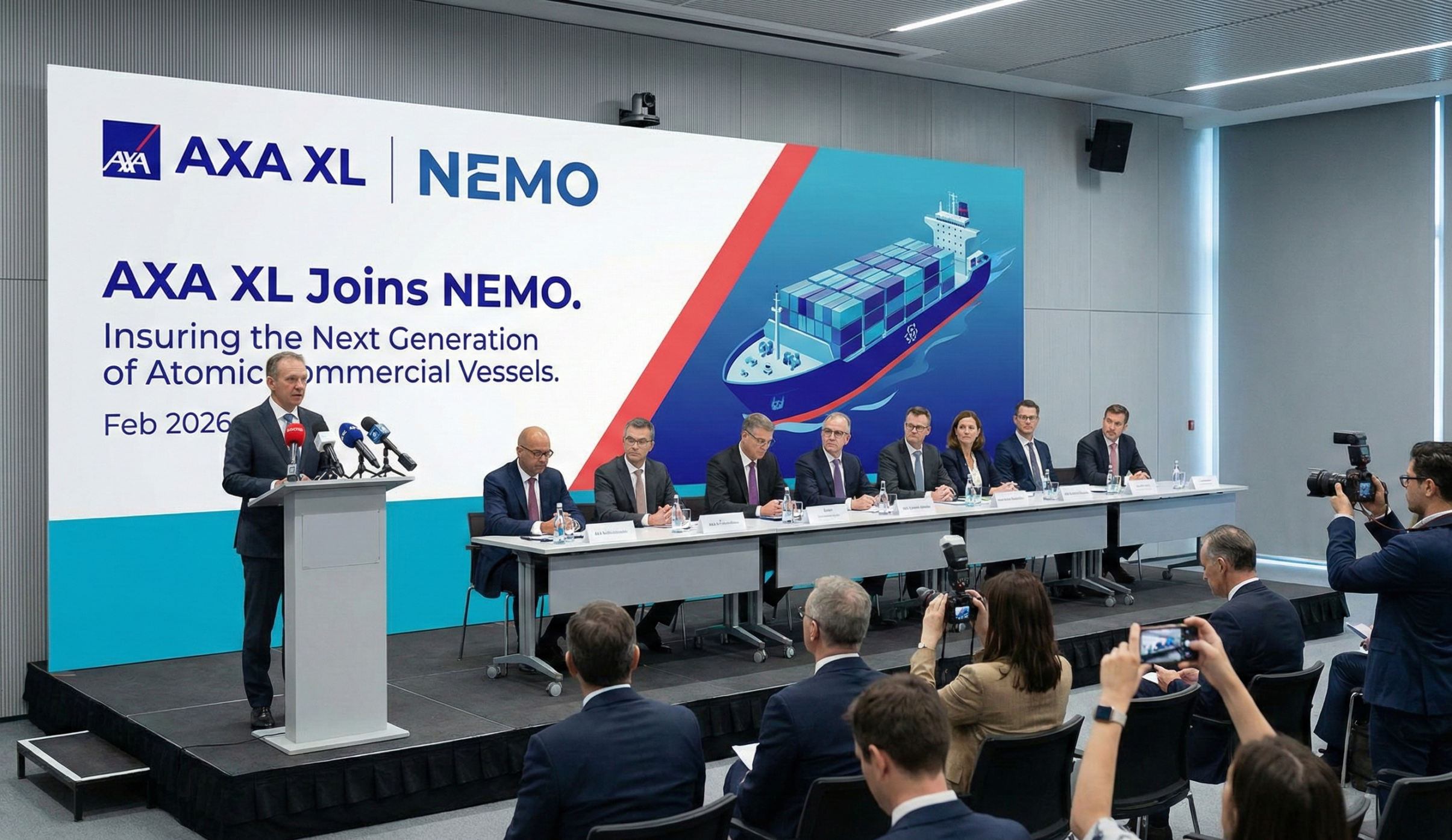
The Rise of Nuclear Maritime Insurance: AXA XL and NEMO Partner to Insure the Next Generation of Atomic Commercial Vessels
The maritime industry is standing at its most significant technological crossroads since the transition from sail to steam. As global trade faces unprecedented pressure to achieve “Net Zero” emissions by 2050, the conversation has shifted toward a power source once reserved for military submarines and specialized icebreakers: Nuclear Propulsion.
In a landmark move for the specialty insurance sector, AXA XL announced in early February 2026 that it has officially joined the Nuclear Energy Maritime Organization (NEMO). This partnership marks the formal entry of commercial insurance giants into the nascent “Atomic Shipping” market—a move that industry experts believe will define the next decade of maritime and energy risk.
1. Why Now? The Drive for Carbon-Free Logistics
The global shipping industry accounts for nearly 3% of all greenhouse gas emissions. While traditional alternatives like LNG, ammonia, and hydrogen are being explored, they often lack the energy density required for massive container ships and ultra-large crude carriers (ULCCs) traveling long-haul routes.
Nuclear power offers a radical solution: a single reactor can power a vessel for its entire 25-year lifespan without ever needing to refuel. However, the primary barrier to adoption has not been just engineering—it has been insurability and regulation. By joining NEMO, AXA XL is taking a seat at the table to create the underwriting framework needed to protect shipowners, ports, and coastal states from the unique risks of seaborne nuclear reactors.
2. Deep Dive: Insuring a “Floating Reactor”
Why is this partnership historic? Because insuring a nuclear vessel is exponentially harder than a standard oil tanker.
- The “Floating Chernobyl” Fear: Public perception is the enemy. Insurers aren’t just covering the hull; they are covering the Liability of a Nuclear Incident in a populated port like New York or Rotterdam.
- The Solution: AXA XL isn’t insuring old-school reactors. They are focusing on New Gen SMRs (Small Modular Reactors). These are sealed, “walk-away safe” batteries that don’t melt down. The insurance challenge is proving to port authorities that these units are safe enough to dock next to a city.
3. Underwriting the Atom: A New Frontier in Specialty Risk
Insuring a nuclear-powered merchant ship is exponentially more complex than traditional hull and machinery (H&M) coverage. Underwriters at the new AXA XL-NEMO task force are focusing on three critical risk pillars as they develop products for 2026 and beyond:
I. Third-Party Liability and Transboundary Risk
Unlike a standard oil spill, a nuclear incident—however unlikely—could have transboundary implications. The specialty market is currently drafting new Nuclear Third-Party Liability (TPL) clauses that align with international conventions, such as the Paris Convention on Third Party Liability in the Field of Nuclear Energy, to ensure adequate compensation mechanisms are in place.
II. Port Access and Salvage Protocols
One of the biggest hurdles is “Port Entry Insurance.” Many global ports currently prohibit nuclear vessels. The industry is working on a “Gold Standard” certification that would provide ports with financial guarantees, ensuring that in the event of a mechanical failure, the vessel can be safely salvaged and contained without environmental fallout.
III. Cyber-Nuclear Security
In 2026, the intersection of AI and nuclear control systems creates a massive target for state-sponsored cyber actors. New specialty policies will likely mandate Real-Time Cyber Monitoring as a condition of coverage, integrating satellite-linked sensor data directly into the insurer’s risk dashboard to detect anomalies in reactor behavior immediately.
4. The Role of NEMO: Standardizing the Unprecedented
Launched to bring together maritime leaders and nuclear innovators, NEMO acts as the bridge between two highly regulated worlds. AXA XL’s membership signifies that the insurance industry is no longer waiting for technology to arrive; they are actively shaping the Safety Management Systems (SMS) that will make these ships viable.
“We are not just insuring a hull; we are insuring a global shift in energy infrastructure,” said a spokesperson for AXA XL’s Specialty division. “Our goal for 2026 is to move from theoretical risk models to a functional insurance product for the first wave of modular reactor-powered vessels.”
5. Market Rankings: Who is Leading the Nuclear Race?
While AXA XL has made the most public move this February, other specialty players are quietly positioning themselves in the “Nuclear Marine” space. According to 2026 Specialty Market Insights, the competition is heating up among the industry’s elite:
| Competitor | Strategy | 2026 Primary Focus |
| AXA XL | Collaborative Partnerships (NEMO) | Regulatory & Port Standards |
| Beazley (Zurich) | Technical Underwriting Innovation | Cyber-Physical Nuclear Security |
| Munich Re | Large-Scale Capacity Provision | Catastrophic Layer Retrocession |
6. Logistics CEO Guide: Preparing for the Atomic Age
If you operate a fleet, nuclear propulsion offers zero emissions and zero fuel costs for decades. But before you order a nuclear vessel in 2027, check these 3 boxes:
Port Access Strategy: Does your route include “Nuclear-Friendly” ports? Currently, many nations ban nuclear vessels. You need an insurer like AXA XL to negotiate the “Gold Standard” certification to get you into the harbor.
Cyber-Nuclear Security: A hacked diesel engine stops the ship. A hacked nuclear reactor is a geopolitical crisis. Your cyber insurance must be military-grade.
Crew Training: You don’t just need sailors; you need nuclear technicians. The insurance premiums will depend heavily on the certification level of your crew.
7. Final Verdict: Green Savior or Dangerous Gamble?
Nuclear ships could eliminate 3% of global carbon emissions overnight. It is the ultimate green solution. But it requires putting reactors on the open ocean. The Big Question: Would you be comfortable living near a port where nuclear-powered cargo ships dock every day? Is the risk of a “maritime nuclear accident” worth the benefit of zero emissions? Vote in the comments.
About the Author