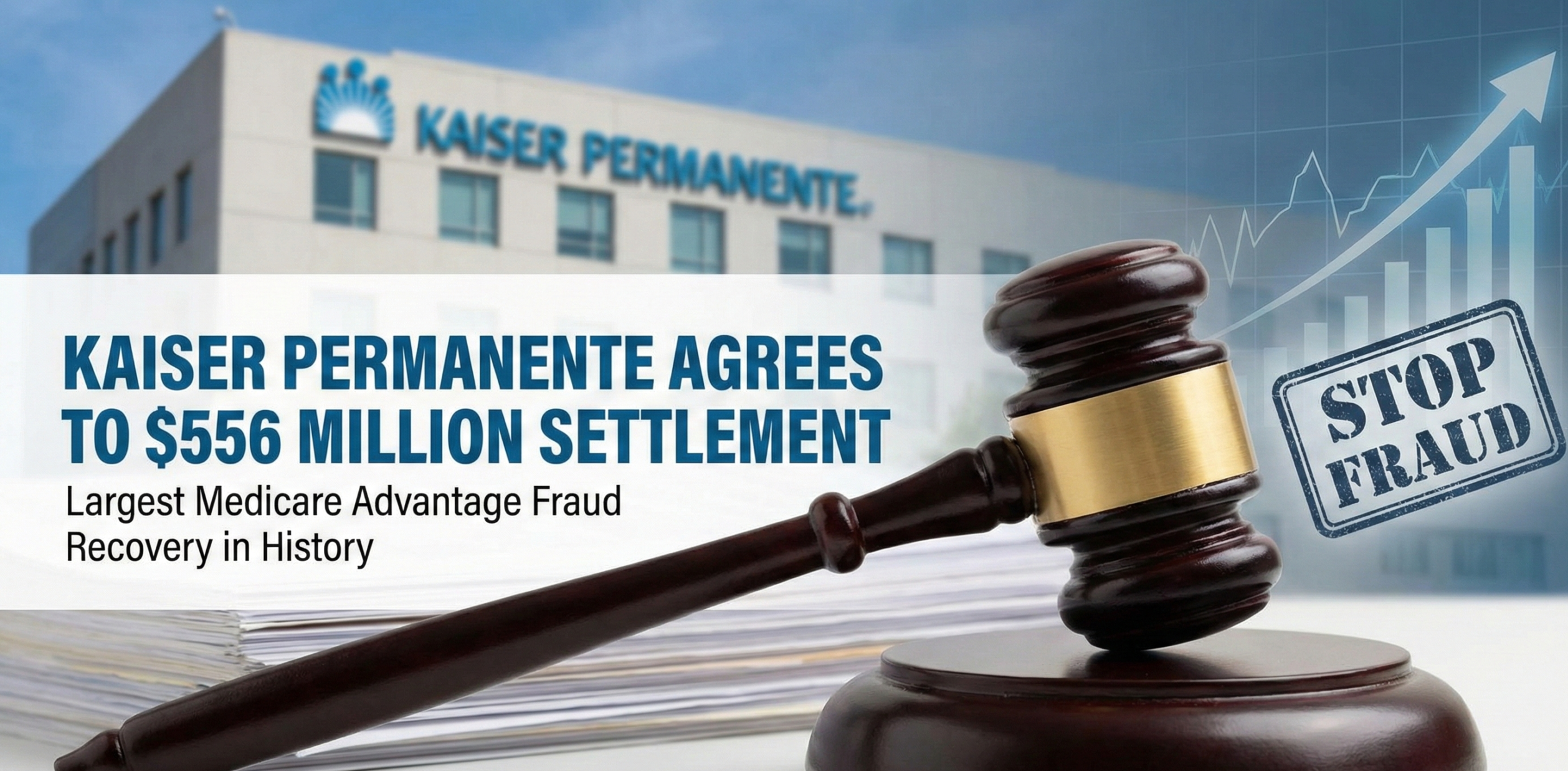
Kaiser Permanente Affiliates to Pay $556 Million to Settle Medicare Advantage Fraud Allegations
The healthcare landscape in the United States has just witnessed one of its most significant regulatory enforcement actions to date. On January 14, 2026, the Department of Justice (DOJ) announced that affiliates of Kaiser Permanente, the Oakland-based integrated healthcare giant, have agreed to pay a staggering $556 million to resolve allegations of violating the False Claims Act.
This settlement marks the largest recovery in history involving allegations of Medicare Advantage (Part C) risk adjustment fraud. It serves as a watershed moment for federal oversight, signaling a relentless crackdown on the “upcoding” practices that have long been a point of contention between the government and private insurers.
1. The Core of the Allegations: Systematic “Upcoding”
At the heart of the government’s case was a sophisticated and widespread scheme designed to inflate the “risk scores” of patients enrolled in Kaiser’s Medicare Advantage plans. Under the Medicare Advantage program, the federal government pays private insurers a fixed monthly amount per enrollee. This amount is “risk-adjusted,” meaning insurers receive higher payments for patients documented as having more severe or chronic health conditions.
The DOJ alleged that between 2009 and 2018, Kaiser affiliates in California and Colorado systematically pressured physicians to alter medical records after patient visits had already concluded. The goal was to add diagnosis codes that:
- Were not addressed during the actual visit.
- Had no clinical relevance to the care provided.
- In some cases, reflected conditions the patients did not actually have.
The “Addenda” Strategy and Data Mining
Federal prosecutors described a “widespread coordinated scheme” where Kaiser utilized internal data-mining tools to scan patients’ past medical histories. When a potential diagnosis was identified that hadn’t been submitted to the Centers for Medicare & Medicaid Services (CMS) for that year, Kaiser allegedly sent “queries” to physicians.
Doctors were encouraged—and sometimes coerced—to add these diagnoses via medical record addenda, often months or even over a year after the patient had left the office. This practice bypassed the fundamental requirement that a diagnosis must be evaluated or treated during a face-to-face encounter to justify a risk-adjusted payment.
2. The “Digital” Diagnosis: How Algorithms Fueled the Fraud
This wasn’t just a case of a few doctors making mistakes. The DOJ described a sophisticated, algorithm-driven engine.
- Data Mining vs. Medical Care: Kaiser allegedly used software to scan patient histories for “high-value” diagnoses that hadn’t been billed recently.
- The “Addenda” Trap: Once the algorithm found a missing diagnosis, doctors were allegedly queried to add it to the medical record—sometimes months after the patient had left the office.
- The Problem: Medicare pays for treating sick people. It does not pay for simply “listing” old conditions that weren’t treated during the visit just to increase the monthly capitation payment.
3. The “Whistleblower” Catalyst: Voices from Within
The massive settlement was made possible by the courage of insiders. The case originated as qui tam (whistleblower) lawsuits filed by former Kaiser employees, including Ronda Osinek and Dr. James M. Taylor, a former medical director at Kaiser.
Dr. Taylor, who was responsible for coding governance and revenue-cycle oversight, reportedly identified systemic practices that prioritized corporate balance sheets over clinical accuracy. When internal warnings were allegedly ignored, he turned to the federal government. As part of the False Claims Act provisions, the whistleblowers are set to receive a significant portion of the recovery—estimated at roughly $95 million—for their role in uncovering the fraud.
“Physicians are trained to document care truthfully and accurately,” said one of the legal representatives for the whistleblowers. “This settlement reminds the industry that chart integrity is not optional—it is a legal and ethical mandate.”
4. Corporate Tactics: “Coding Parties” and Incentives
The DOJ’s complaint painted a picture of a corporate culture intensely focused on maximizing Medicare reimbursements. The government alleged that Kaiser:
- Hosted “Coding Parties”: Gathering physicians in rooms to work through lists of past diagnoses and manually add them to current records.
- Ranked Physicians: Publicly flagging “underperforming” doctors and facilities that were not adding enough diagnosis codes.
- Linked Bonuses to Coding: Tying financial incentives and executive bonuses directly to meeting risk-adjustment targets.
These tactics, the government argued, created a high-pressure environment where the financial health of the organization superseded the accuracy of medical documentation.
5. Industry-Wide Implications: The End of an Era?
The $556 million settlement dwarfs previous benchmarks in the Medicare Advantage space. To put this into perspective, it far exceeds the 2023 settlement with Cigna ($172 million) and the 2024 settlement with Independent Health ($100 million).
A New Standard for Compliance
This case underscores a critical shift in DOJ strategy. Historically, many risk-adjustment disputes were handled through administrative audits. Now, the government is increasingly treating these discrepancies as civil fraud.
For the broader insurance and healthcare sector, the message is clear:
- AI and Data Mining are Under Scrutiny: While technology can help identify gaps in care, using it solely to “mine” for billable diagnoses without clinical follow-up is now a high-stakes legal risk.
- Internal Compliance Must Have “Teeth”: The DOJ specifically noted that Kaiser ignored its own internal audits and physician complaints. In the future, “paper compliance” programs will not protect companies if they fail to act on red flags.
- The Rise of Personal Liability: While this settlement was corporate, federal agencies have signaled a growing interest in holding individual executives accountable for overseeing fraudulent coding schemes.
6. Kaiser’s Response
In a public statement, Kaiser Permanente maintained that it chose to settle to “avoid the delay, uncertainty, and cost of prolonged litigation.” The organization did not admit to any wrongdoing or liability. Kaiser officials emphasized their commitment to providing high-quality, integrated care and suggested that the dispute was largely a matter of “differing interpretations” of complex and evolving CMS coding rules.
However, as part of the resolution, Kaiser will likely be subject to a Corporate Integrity Agreement (CIA) with the HHS Office of Inspector General, requiring years of independent monitoring and rigorous reporting on its coding practices.
7. Why You Should Check Your Medical Record
While the $556 million fine goes to the government, the “upcoding” practice has real-world consequences for patients like you:
- The “Paper” Patient: If your doctor adds severe diagnoses to your file to satisfy an algorithm, you might look much sicker on paper than you really are.
- Future Insurance Risk: While pre-existing conditions are protected now, accurate records are vital for life insurance and long-term care policies. Having a “phantom” diagnosis of heart failure or severe diabetes (added just for billing) could complicate your future financial planning.
- Trust Breakdown: This settlement begs the question: When your doctor suggests a diagnosis, is it because you have it, or because a corporate “Coding Party” requires it?
8. Final Verdict: The Cost of Doing Business?
Kaiser Permanente settled to “avoid the uncertainty of litigation” and admitted no liability. For a giant generating nearly $100 billion in revenue, a $556 million fine is less than 1% of its income. The Big Question: Do fines like this actually stop corporate fraud, or are they just viewed as a “speeding ticket” by massive healthcare insurers? Should executives be held personally liable instead? Sound off in the comments.
About the Author