
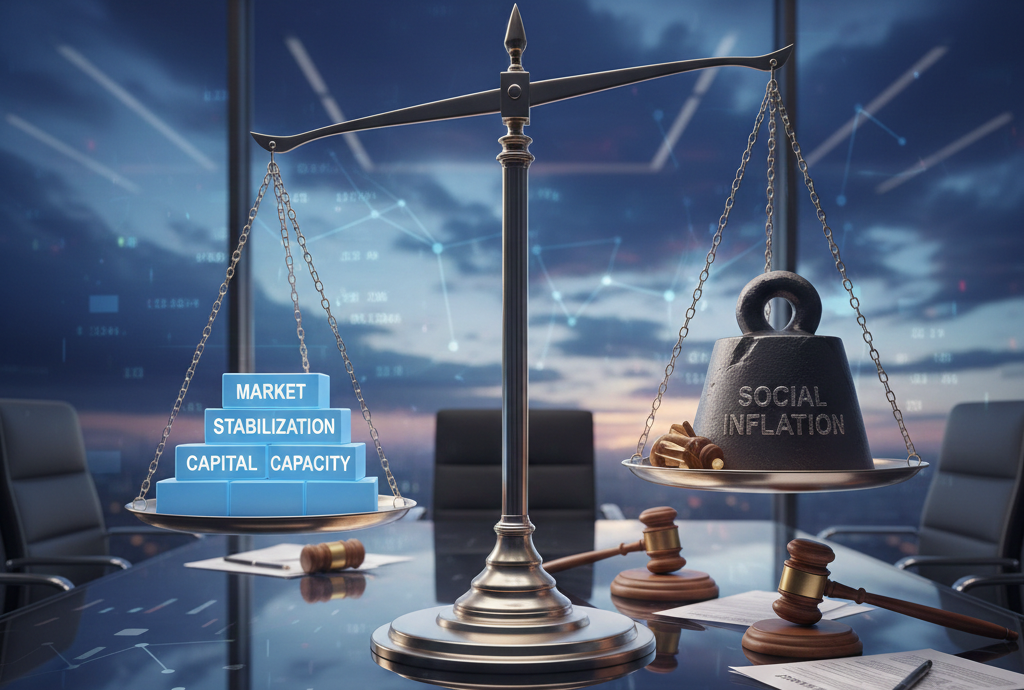
U.S. Commercial Insurance Market Shows Stabilization Despite Legal and Competitive Pressures
As the U.S. commercial insurance market enters 2026, the prevailing narrative is one of calculated stabilization. After years of historic volatility—fueled by a global pandemic, supply chain collapses, and the “hard market” cycle—insurers and policyholders are finally finding a steadier footing.
However, this stability is not a return to the “soft” markets of the past. Instead, it is a period of market recalibration. While overall premium growth is slowing, the industry remains under immense pressure from a “bifurcated” risk landscape. While property rates are showing signs of relief, casualty lines are being squeezed by aggressive litigation tactics and the persistent threat of social inflation.
For the readers of PolicyNewsHub.com, this deep dive explores the mechanics of this stabilization and the legal and competitive forces that are shaping the commercial insurance landscape in 2026.
1. The Macro-Outlook: A Shift from Catch-Up to Consistency
In 2026, the U.S. Property and Casualty (P&C) sector is projected to maintain strong underwriting profitability. According to recent reports from Fitch Ratings and Swiss Re, direct premiums written are expected to grow by a modest 4% in 2026, a significant deceleration from the double-digit jumps seen earlier in the decade.
This cooling of rate momentum is a clear sign that the industry’s “catch-up” phase—where insurers hiked rates to offset the spike in reconstruction costs and medical inflation—is nearing its end.
Key Indicators of Stability:
- Combined Ratios: Analysts expect the industry-wide combined ratio to normalize between 96% and 97% in 2026. This indicates that insurers are pricing risk accurately enough to remain profitable while absorbing claims.
- Abundant Capacity: Reinsurance capital has reached record levels, exceeding $725 billion. This influx of capital is creating a “buyers’ market” in certain lines, particularly in commercial property, where shared and layered placements are seeing rate decreases of 10% to 30% for well-managed risks.
2. Deep Dive: Why “Stability” is a Technical Illusion
Why is the market leveling off now? Our analysis suggests it’s not because risks have disappeared, but because of Market Recalibration.
- The Valuation Plateau: After three years of aggressive hikes, most businesses have finally updated their property values. Insurers have “caught up” with inflation, so they can afford to stop raising rates—for now.
- The Captive Pressure: Mid-sized firms are fleeing to “Captives” (self-insurance) at record rates. Traditional insurers are being forced to stabilize prices simply to stop the exodus of their best clients.
3. The Great Bifurcation: Property Eases While Casualty Firms
The defining characteristic of the 2026 market is its split personality. The stabilization seen in the headlines is often an average of two very different realities.
The Property Market Correction
Driven by a relatively benign 2025 hurricane season and improved data modeling, the Commercial Property market is the primary driver of stabilization.
- Valuation Accuracy: After years of friction over “undervalued” assets, most policyholders have now updated their replacement cost valuations. With this “valuation gap” closed, underwriters are more willing to compete on price for “clean” accounts.
- Incentivized Mitigation: Insurers are increasingly offering premium credits for businesses that implement “home-hardening” or “site-resiliency” measures, such as reinforced roofing or IoT-based water leak detection.
The Casualty Conundrum
Conversely, General Liability, Commercial Auto, and Excess Umbrella lines remain “firm.” Even as other rates stabilize, these lines continue to see increases in the high single digits. The reason is simple: while you can rebuild a warehouse for a predictable cost, you cannot easily predict the cost of a jury verdict in 2026.
4. Legal Pressures: The Shadow of Social Inflation
If there is one force threatening the market’s hard-won stability, it is Social Inflation. This term describes the rising costs of insurance claims due to socioeconomic and legal trends that drive bigger lawsuits and larger payouts.
The Era of “Nuclear Verdicts”
In 2026, “nuclear verdicts”—awards exceeding $10 million—have become a frequent occurrence rather than a rare anomaly. Juror sentiment has shifted toward an anti-corporate bias, with many perceiving large corporations as having “infinite pockets.” This has made the Excess and Umbrella layers particularly volatile, as insurers are forced to pay out policy limits more frequently.
Third-Party Litigation Funding (TPLF)
The U.S. legal landscape is also being reshaped by a $17 billion global litigation funding industry. Outside investors are now financing lawsuits against corporations in exchange for a cut of the settlement.
- Extended Litigation: TPLF allows plaintiffs to prolong cases that might have previously settled, driving up defense costs for insurers.
- Higher Demands: With investors expecting a return, settlement demands are often pushed significantly higher than the actual economic damages.
5. Competitive Pressures and Market Innovation
While legal risks are a headwind, competitive pressures are acting as a stabilizer. Insurers are no longer just competing on price; they are competing on technology and data.
The Rise of Data-Driven Underwriting
In 2026, “blind underwriting” is a thing of the past. Carriers are using real-time data from:
- IoT and Telematics: For commercial fleets, telematics data is now a mandatory requirement for competitive pricing.
- Satellite and Drone Imagery: Property underwriters use AI-powered aerial analysis to verify roof conditions and proximity to brush before even issuing a quote.
The “Captive” Revolution
Fed up with the volatility of the traditional market, more mid-market firms are forming or joining Captive Insurance companies. By “becoming their own insurer” for predictable risks and only buying commercial insurance for catastrophic events, businesses are exerting a downward competitive pressure on traditional carriers, who must now offer more flexible “Alternative Risk Transfer” (ART) solutions to keep their clients.
6. Emerging Risks on the Horizon for 2026
Stability does not mean the absence of risk. As we navigate 2026, three emerging categories are keeping the industry on its toes:
- AI Liability: As companies integrate Generative AI into logistics, hiring, and customer service, insurers are rolling out specialized policies to cover algorithmic bias and automation breakdowns.
- Directors & Officers (D&O) Pressures: While D&O pricing has moderated, boards face new legal threats from insolvency claims (expected to rise 5% globally in 2026) and failure to manage cyber-resiliency.
- Cyber Interruption: Cybersecurity is no longer just about data theft; it’s about systemic business interruption. The 2026 market is seeing a high demand for coverage that protects against massive cloud-provider outages.
7. Risk Manager’s Action Plan: Navigating 2026
Don’t let the word “stable” make you complacent. Take these proactive steps during your next renewal cycle:
Weaponize Your Data: In 2026, underwriters won’t give you the best rates just for asking. Present 24 months of telematics (for fleets) or IoT water-leak detection logs to prove you are a “Preferred Risk.”
Audit Your “Excess” Layers: With Social Inflation rising, check if your $5M umbrella policy is still enough. In the era of Nuclear Verdicts, what was “sufficient” in 2023 is “underinsured” in 2026.
Negotiate Multi-Year Terns: Since Property rates are currently easing, try to lock in 2-year rate guarantees before the next major climate event shifts the market again.
8. Final Verdict: Efficiency vs. Litigation
The U.S. insurance market has proven its resilience, but it is now a game of two halves. We are seeing a race between technological efficiency (AI underwriting) and legal system costs (Social Inflation).
The Big Question: Do you believe stricter tort reform is necessary to keep insurance affordable, or are “Nuclear Verdicts” a fair price for corporate accountability? Join the discussion in the comments below.
About the Author