WTW Completes $1.3B Acquisition of Newfront, Fusing Silicon Valley Tech with Global Brokerage Power
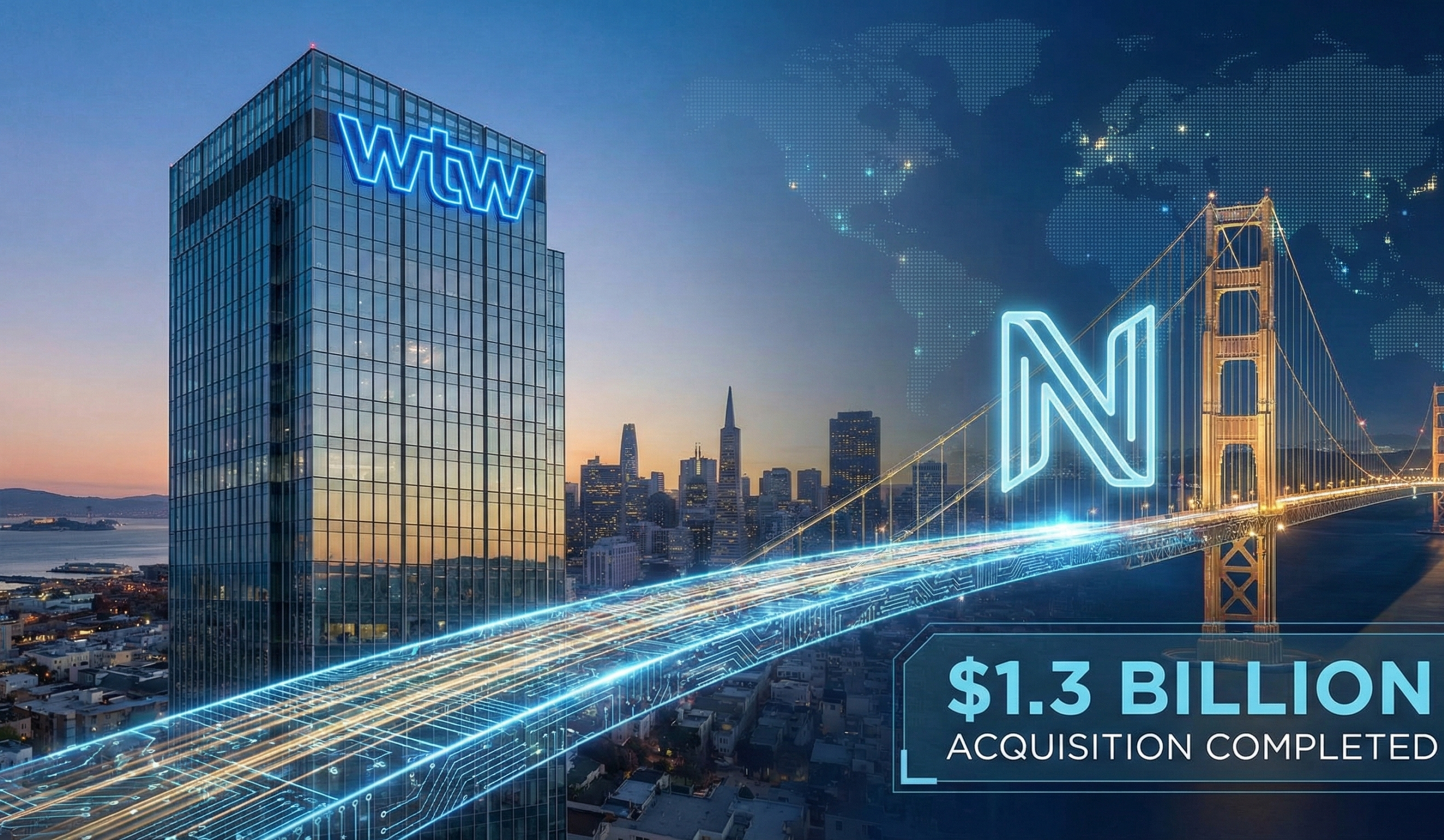
The landscape of the global insurance brokerage market has shifted. WTW (Willis Towers Watson), a premier global advisory and broking firm, officially announced the completion of its $1.3 billion acquisition of Newfront on January 27, 2026.
This move is far more than a standard consolidation of market share; it is a calculated fusion of Silicon Valley’s technological DNA with the institutional weight of a global insurance powerhouse. By integrating Newfront’s “technology-native” approach, WTW is positioning itself to dominate the U.S. middle market and redefine the digital experience for high-growth industry sectors.
1. The Financial Architecture of the Deal
The acquisition, valued at a total consideration of up to $1.3 billion, reflects the premium WTW is willing to pay for innovation. The deal structure is designed to align the interests of Newfront’s leadership and its high-performing producers with WTW’s long-term growth targets:
- Upfront Consideration: $1.05 billion, consisting of approximately $900 million in cash and $150 million in equity paid to Newfront employee-shareholders.
- Performance Incentives: Up to $250 million in contingent consideration, primarily in equity, based on specific performance targets.
- Growth Bonuses: An additional $150 million available if Newfront achieves above-target revenue growth following the third anniversary of the closing.
- Retention Focus: WTW has committed $100 million in equity-based retention incentives to ensure Newfront’s elite team of over 120 producers remains the engine of the new division through 2031.
2. Silicon Valley Meets Global Risk: The Tech Integration
The core driver of this acquisition is Newfront’s proprietary technology stack. While traditional brokerages are often hampered by legacy systems and manual paperwork, Newfront was built from the ground up as a digital platform.
Agentic AI and Automation
Newfront has distinguished itself through the use of agentic AI—artificial intelligence capable of autonomously managing complex workflows. WTW plans to leverage this technology to create an integrated, end-to-end ecosystem that will:
- Accelerate Underwriting: Reducing the time between initial inquiry and policy issuance.
- Enhance Transparency: Providing clients with real-time, data-driven dashboards to monitor their risk exposure.
- Operational Efficiency: WTW expects to achieve $35 million in run-rate cost synergies by the end of 2028 through technology-led streamlining.
3. Deep Dive: What is “Agentic AI” in Insurance?
The buzzword of this deal is “Agentic AI,” but what does it actually mean for a client? Unlike ChatGPT, which just writes text, Agentic AI acts.
- The Old Way: You email your broker for a quote. They email an underwriter. They wait 3 days. They email you back.
- The Newfront Way: The AI reads your email, pulls your risk data, fills out the carrier forms, negotiates the quote parameters, and presents the broker with a “ready-to-sign” option.
- The WTW Strategy: By deploying this tech across WTW’s massive global network, they aren’t just cutting costs; they are trying to automate the boredom out of insurance so brokers can focus purely on strategy.
4. Dominating the U.S. Middle Market
A key strategic goal for WTW is expanding its footprint in the U.S. middle market, a segment characterized by companies with specialized needs but less access to global risk analytics. Newfront’s expertise in high-growth, high-margin sectors—specifically Fintech, Technology, and Life Sciences—provides WTW with an immediate competitive advantage.
Newfront’s two primary business segments have been seamlessly integrated into WTW’s existing structure:
- Business Insurance: Now part of WTW’s Risk & Broking (R&B) segment.
- Total Rewards: Combined with WTW’s Health, Wealth & Career (HWC) segment.
This integration allows WTW to offer middle-market clients the specialized, localized service of a boutique broker with the analytical “firepower” of a top-three global firm.
5. Leadership and Cultural Synthesis
Maintaining the culture of a Silicon Valley “disruptor” within a multi-billion dollar corporation is a challenge WTW CEO Carl Hess is eager to tackle. “Combining Newfront’s technology-enabled broking model with WTW’s global footprint will enhance our delivery of innovative solutions,” Hess stated.
Spike Lipkin, Co-Founder and CEO of Newfront, has joined the WTW team with a specific focus on technology integration, talent acquisition, and client development. The preservation of Newfront’s identity is vital; WTW is betting that Lipkin’s team can act as a “digital incubator” for the entire global organization.
6. Client Playbook: What to Expect in 2026
If you are a mid-market CEO or CFO currently using WTW or Newfront, here is how this merger affects your renewal:
The “Integration Tax”: Be patient. Mergers of this size often lead to 6-12 months of backend glitches. Keep a close eye on your invoices and policy docs during the transition period.
For Legacy WTW Clients: Expect a digital upgrade. You will likely be migrated to Newfront’s dashboard, giving you real-time transparency into your policies (finally getting rid of those PDFs and spreadsheets).
For Newfront Clients: Don’t panic about losing the “startup feel.” The retention of Spike Lipkin and the $100 million staff incentive pool suggests your account team isn’t going anywhere. Plus, you now have access to WTW’s global placement power for complex international risks.
7. Final Verdict: Can Oil and Water Mix?
This is the most aggressive attempt yet to merge “Silicon Valley Speed” with “London Market Tradition.” If it works, WTW becomes the broker of the future. If it fails, it will be just another expensive culture clash. The Big Question: Do you prefer your insurance broker to be a tech-savvy advisor armed with AI, or do you miss the traditional relationship-based model? Can WTW maintain the “human touch” while automating the workflow? Share your thoughts below.
About the Author